Review: Beyma 14MLEX1000Nd
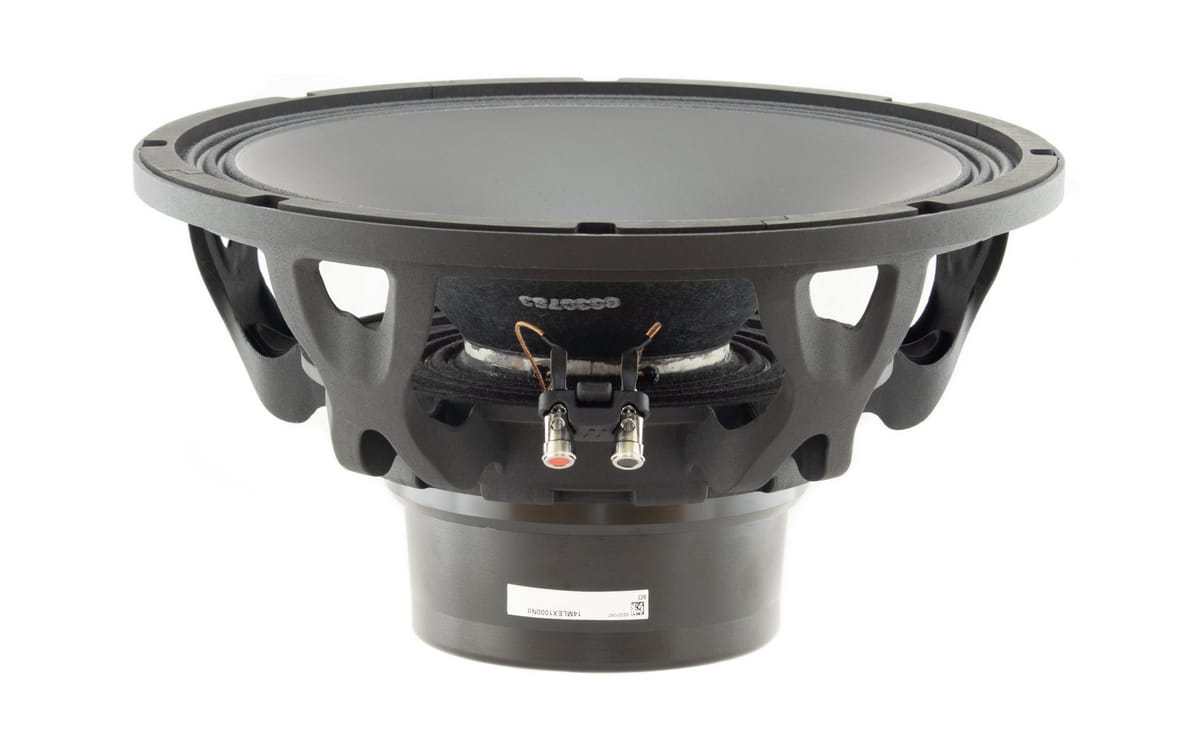
Norms broken. Dimensions ignored. That was the way of looking at things for some time when it came to these sizes. Now, these are not unconventional anymore. Following that spirit, Beyma also introduced its entry into the mid-size class: the 14MLEX1000Nd - a driver large enough to deliver serious sound pressure levels, in the newer compacted package.
Why 13.5"? Why 14"? Why 16" and 19"?
Why not stick to the long-standing dimensional standards of driver design? That could be a long essay for a very rational situation. Let’s skip that.
We don’t do these drivers just because we can. These dimensions do bring comfort in logistics and handling, and they are creeping into the mainstream rather fast.
Currently Beyma offers two 14-series speaker models in its portfolio. After 14MLEX1000Nd, there is 14MC700Nd (tested at bassometry.com as well), more light and sensitive brother for midrange duties, while the MLEX unit is more equipped for full-range or extended mid-bass work.
This review was sponsored by MS-Sound (www.ms-sound.cz), who kindly provided the speaker for testing. While sponsorships are very welcome, all technical results and measurements remain completely independent.
Looks and build quality:
If sleekness was a speaker, this would be it.
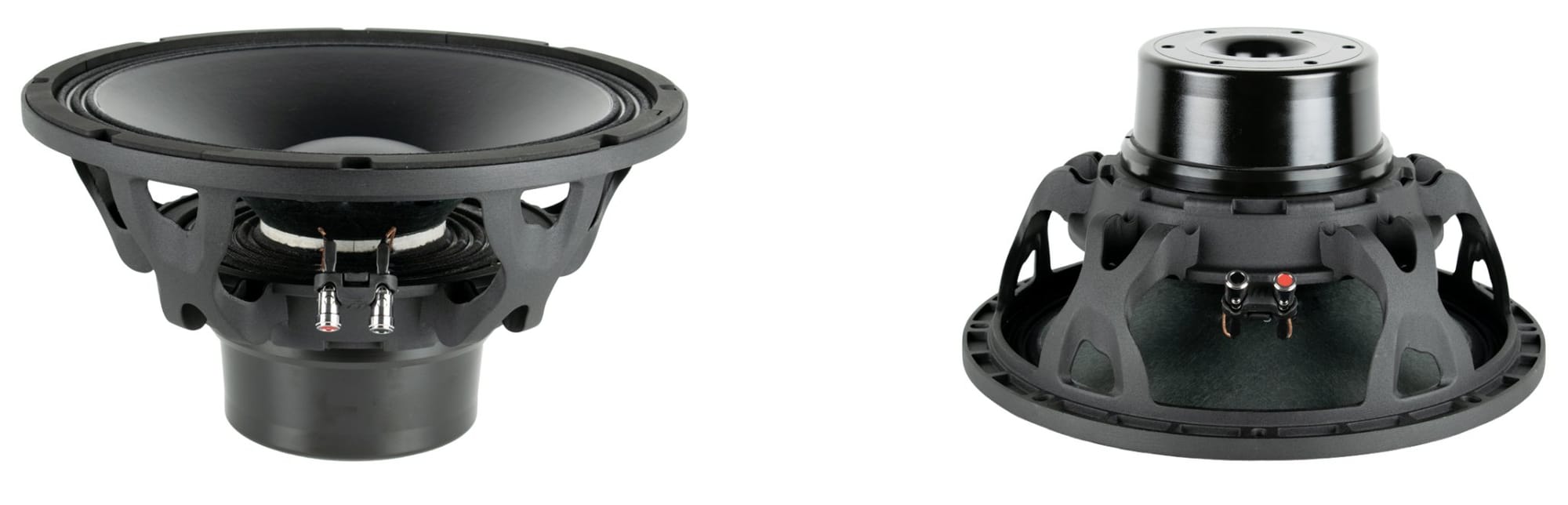
At first glance, Beyma 14MLEX1000Nd gives off that incognito, plain, reference look — not even disrupted by Beyma’s now-familiar X-shaped spoked basket. The moderately heavy, “wetted-look” cone coating, dark spider, and distinctive yet still design-wise understated magnet return cap, all add to that dark horse vibe. Maybe the copper-color tinsel leads woven into the spider break that visage a little.
Let’s peek under the hood:
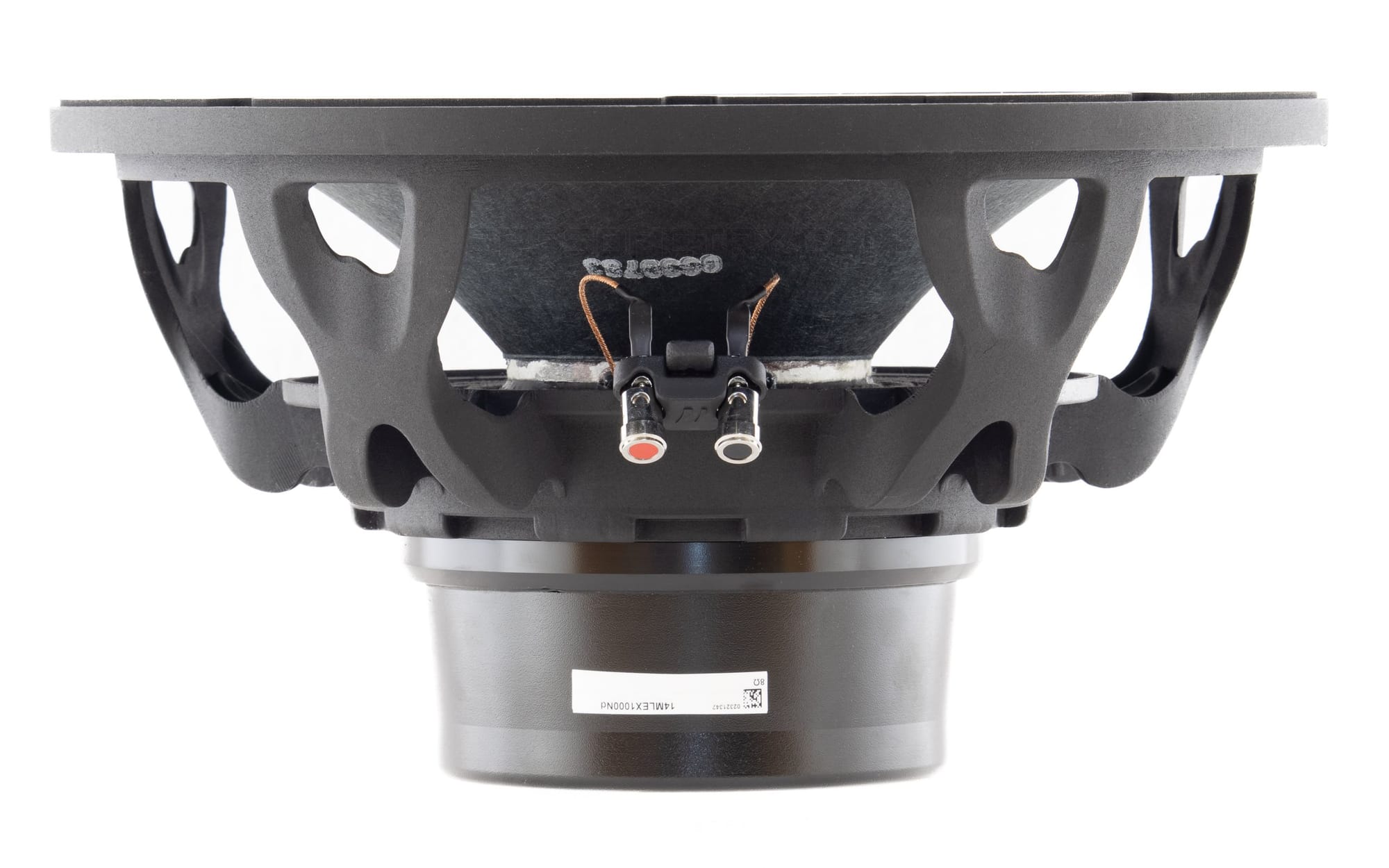
On a 14.13"diameter basket platform sits fairly deep curved smooth cone. 7" Conex spider with roughly 3.5 corrugations centers a 4" inside-outside copper-wound voice coil It is a single spider design with advanced heat and fatigue resistance, yet not quite positioned in full subwoofer-grade territory, to keep things moving efficiently for midbass workloads. Fairly stiff 5,5"-ish dustcap glued to the speaker cone blends in the plain design.
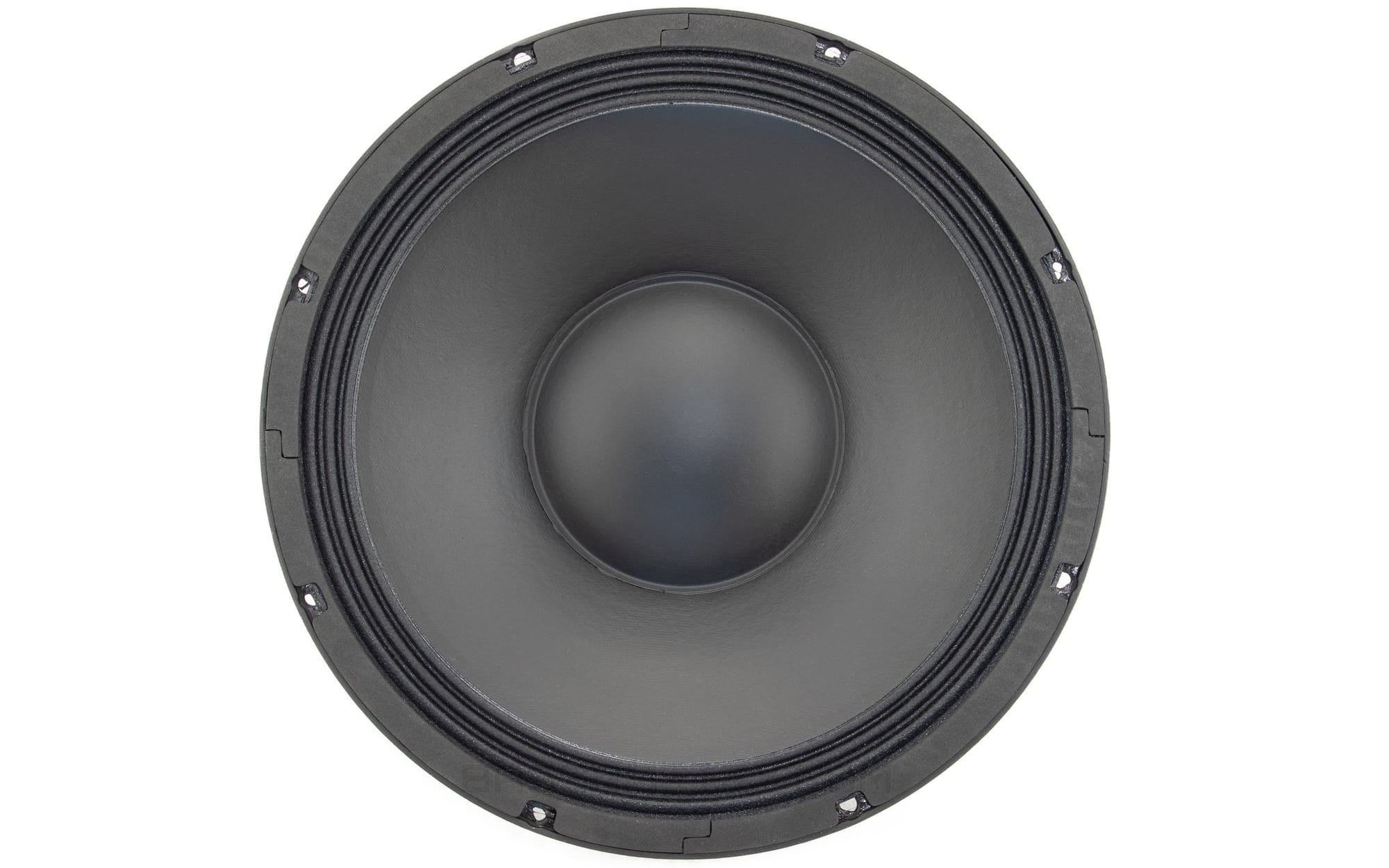
Beyma markets this model as a low, and mid-frequency transducer, and while it can certainly handle some basic bass duties, it’s not built for constant punishment around or above Xmax. The cone’s design adds to that vibe - capable of bass, but not the kind that forgives reckless abuse or heavy horn compression. For midbass or full-range work, though, it looks more than solid and confidently engineered. On touch, it feels stiffer than competing products for sure.
Will I spare it from the inevitable abuse? Of course not. In the spirit of “Will it bass?”, I´m putting the foot down.
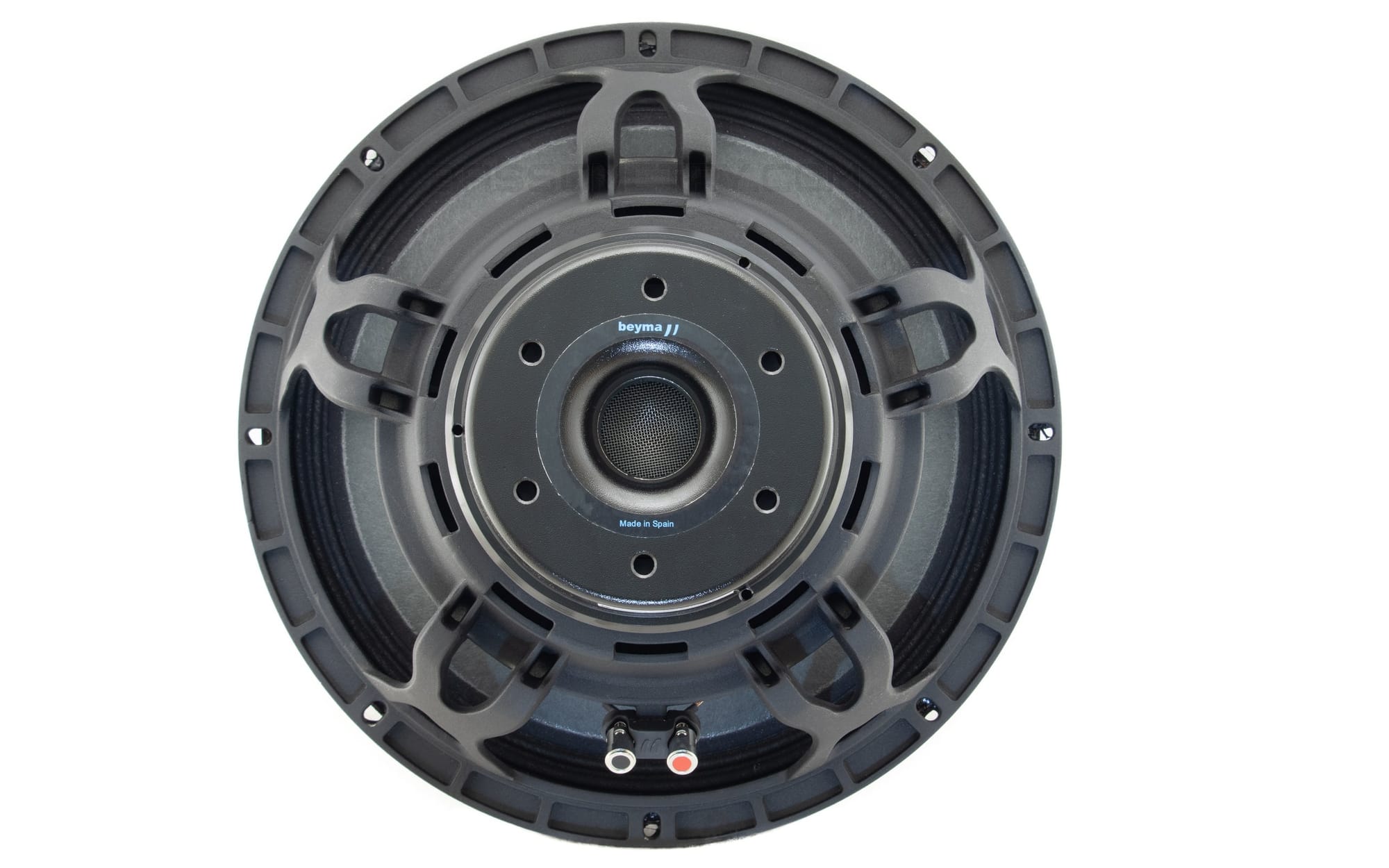
The magnet cap measures 144 mm in diameter, expanding another 10 mm toward its base, into ~170 mm including top plate. The motor assembly stands 70 mm tall. A flared center vent is 44 mm wide and 70 mm deep before it meets inner protection wire mesh. Around the voice-coil axis, six 7.5 mm vent holes provide direct cooling, while another ten openings at the basket base complete a notably airy design implied by Beyma´s own claim of "Ultra low air noise".
More design efforts were summed into the features and specs overview:
● Low power compression losses
● Optimized linear behaviour
● Extended controlled displacement: Xmax ± 11 mm
● Exclusive Malt Cross® Technology Cooling System
Let´s stop here at the Xmax figure. For a midbass driver, that´s a lot. Seemingly over the top. Almost too much. In closer look, mathematical Xmax derived from voice coil length and pole piece thickness gives us 7 mm coil overhang. 7mm of excursion with rather fully utilized voice coil, and then some for the peaks. What does that mean really? More coil mass deals better with heat dissipation, full pole piece coverage gives us low distortion figures at the excursion limits of midbass work, and ~8mm excursion is also usual doppler distortion limit for clean output if we crossover properly. With modern, even higher excursion subwoofer drivers, I believe this will be the new trend. A midtop section giving adeqate output down to 80Hz, to strongly support true subwoofers.
Driver specifications:

- Size: 14" type
- Power Handling: 1000 W AES
- Impedance: 8 Ohm
- Frequency Range: 50-4500 Hz
- Sensitivity: 99 dB (1W/1m)
T&S parameters set:
Xmax of 11mm is very respectable as is, for any midbass driver, albeit a heavy type one. The measured Xmax value includes a “plus” suffix, as the driver performs admirably under overload conditions - maintaining control and composure beyond its rated excursion.
Now, measured T&S parameters are a fair match for a broken-in new unit (by my test procedure) with better Q values - Qes and Bl are very slightly above the published specs. But we can see changes in the suspension and compliance department, causing all that.
Continuning with manufacturer´s supplied frequency response:
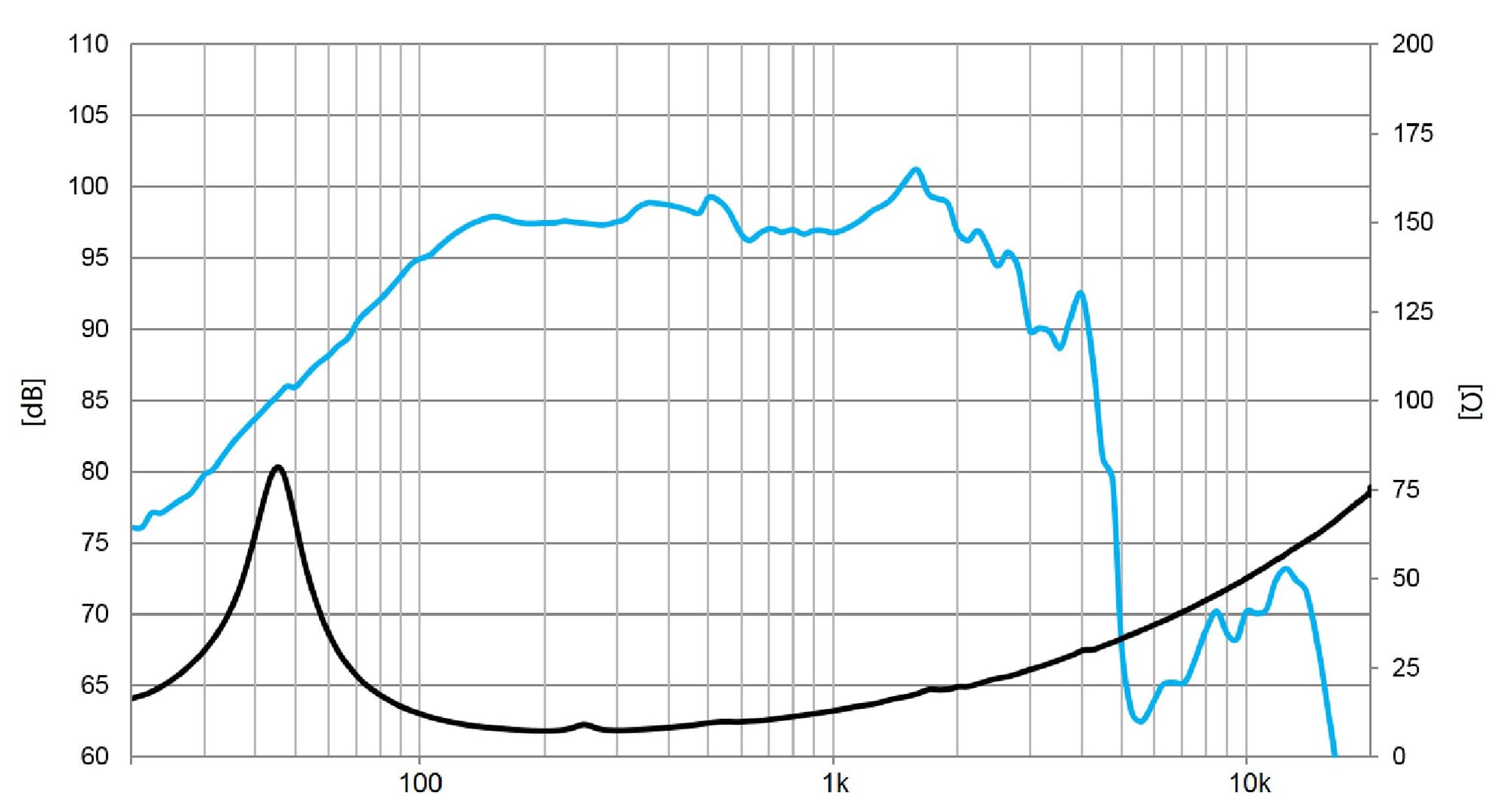
Below attached is the product datasheet:
Performance overview and general rating:
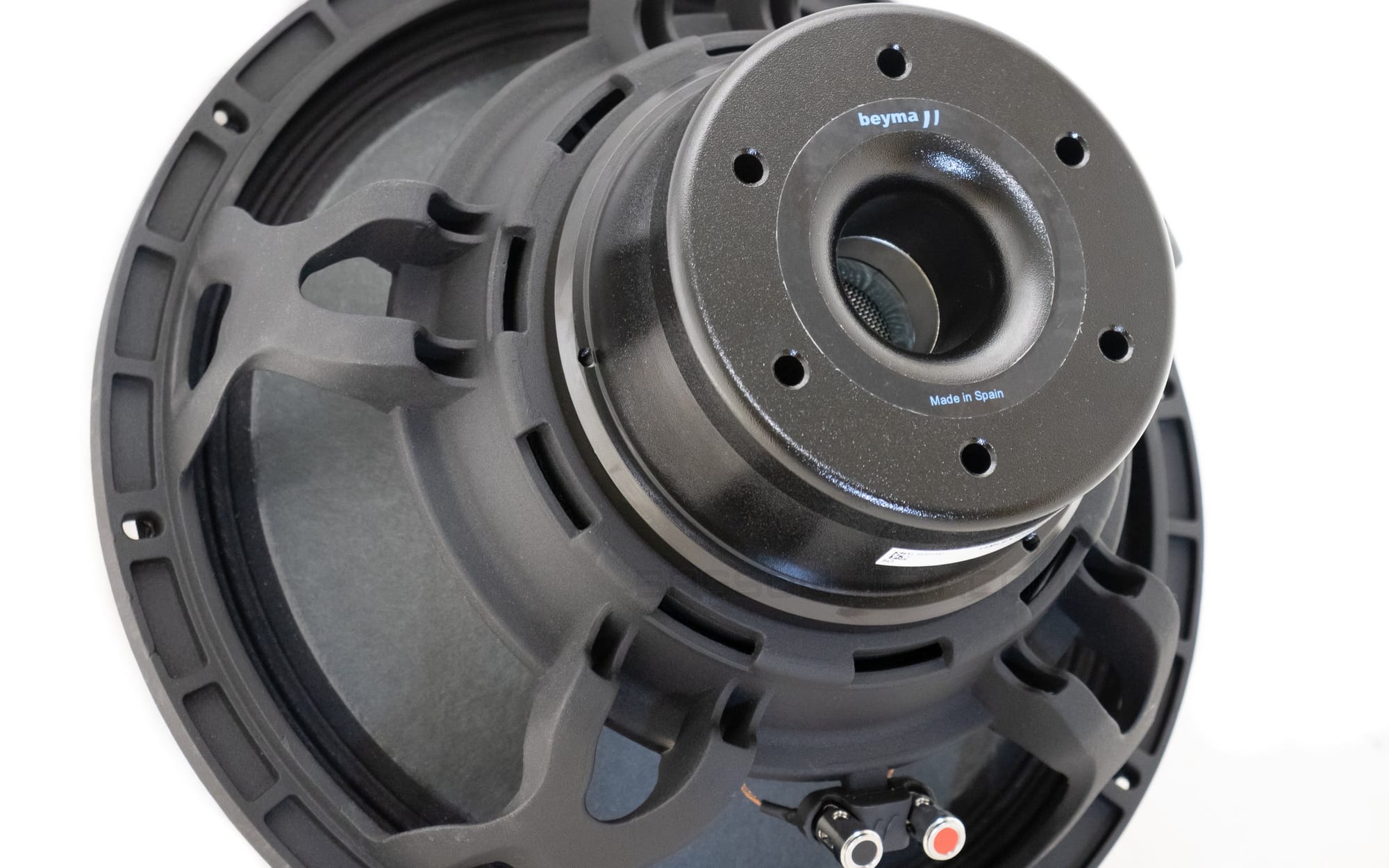
The driver performed well within its specifications for intended use. In free air, it sounded strong and snappy; lively and "shouty" for a midbass unit in a way to be liked for live sound. The driver was more than able to excite my 33Hz room mode even in free air configuration. No doubt this unit can do bass.
Advertised "ultra low self noise" claim works great for sinusoidal signal, for program content less so. The motor is audible, having that typical fast change air movement grunt when pushed to Xmax. Good thing is, that with 14" cone, the ratio of self noise and needed output is better than with 12" units. Still audible in use, but now rather positively passable. It is an inevitable compromise, and I believe Beyma handled that one favourably.
All the performance is paid for with some kind of price. In this case, it is weight - To keep big coils and strong cones running, it is 9,2 kg for a midbass. That is not a little, and monetary price is not to be ignored either.
- Buy if: You want a high end midbass driver for proper full range work, or for integration with modern large excursion subwoofers crossed 80Hz and lower.
- Skip if: You want to move a lot of air by a light driver for little money.
The displacement-to-dollar score again makes it clear: this is a driver built for specific applications. I’d not recommend it blindly for general-purpose builds, or for scenarios where displacement to price ratio matters. Once we assign the driver to the type of suggested use, this issue gets rather resolved.
*The following section is available to Bassometry members only.* (Free sample):
Large Signal Performance Results:
This section presents the driver’s behavior under high excursion and high power conditions. Measurements are conducted using controlled lab procedures to reveal transducer behavior beyond small-signal specs. For a full explanation of the test methodology, please refer to our Bassonomy section.
Upon first test signal injection, I must say I was impressed. A midbass or fullrange driver behaving good past 11 mm of excursion one way is no small feat. Let´s unpack the performance details:
Measured data look VERY strong. In the case of resonance frequency shift of just 15.3%, the shift figure appears too strong again, due to the pre-test resonance change caused by the burn-in procedure. The driver score has been handicapped by proper value ending up in still excellent 90.2% score still.
Impedance shift at Xmax of 57,6% indicates more of the nonlinear creep/behavior of high compliance drivers. Together with the permanent resonance frequency shift, from that point, the driver performed in fully stable manner despite further abuse.
DC cone offset at 15Hz: 0.11mm (1%) frontward offset shows remarkable control despite softer suspension. Very solid outcome.
15 Hz – 75 Hz at Xmax (Sweep) behavior:
During frequency sweeps, the offset rose to 0.2 mm until 50Hz. Impeccable performance showing not only good centering but also excellent underlying control of the magnetic circuit. Raising the driver abuse to 75Hz at Xmax, I could see onset of notable but controlled shift with 1.8 mm forward offset. At these frequencies, this is expected, and within the bounds of a good driver. Most drivers will show center cone position shift above 50Hz.
Power draw tests: All ending up with 100% respective scores. These point to the looser suspension, giving this driver favourable sensitivity figures needed for mid-bass use, as well as very strong motor to move the soft parts efficiently.
THD figures: 4.8% and 1.9% THD for 15Hz and 50Hz respectively tell us more of the story. The driver indeed has a lot of excursion to work with while still remaining cultivated and controlled.
Excursion behavior:
Here, usable excursion would have risen to +3 dB above Xmax, especially mechanically and in terms of distortion as well, while moving the speaker cone by 14.4 mm each direction. The 14MLEX1000Nd also absorbed +4 dB boost past Xmax without any reliablity issues at that time. While it sounded mildly stressed, its small-signal T&S parameters showed no noticeable change afterward (other than further small Fs shift that healed after 48 hour resting period).
The usable excursion score was ultimately reduced to +1 dB above Xmax, due to the previously mentioned Fs shift upon burn-in.
Mechanical(SPL) compression:
With 14MLEX1000Nd, we can see similar values throughout their product line upto Xmax limit again, showing "long" suspension with superlinear behavior. This is preferred for midbass work, up to the survival capabilities of the suspension itself.
Final words:
This is a very strong mid-bass driver that brings previously unexpected output and (mid)-bass performance to full-range systems and systems that can no longer be feasibly crossed over at 100+ Hz. The competition offers various alternatives, but not a favourably sized 1000 W unit with coil headroom to spare for higher than usual peaks in the program material. Being able to deliver that “buttery-smooth”, full “mid-bass bath” experience might not be goal of a local basshead, yet it certainly is for this class of product, and anyone solving the whole rig concept.
The weight and monetary cost are basically inevitable; there is no fair reason to bash this driver for being exactly what it is designed to be. Just be prepared that a compact box does not always mean a light box. It will be a dense cluster of speaker technology.
For outright heavy bass duty, the 14MLEX1000Nd might appear slightly under-equipped in its soft parts, but a 500-hour strain and aging test was conducted in spite of that knowledge, to determine whether the unit can fully support the extended excursion specification.
Excitingly, I can present the fact that the driver survived prolonged overload bursts above its specifications and long days of sinewave tone aging as well. With 11mm of Xmax and survival even above that mark, it can be concluded that "this is a bass driver as well". Honoring its now more than believable extended excursion capability in addition to overall great performance - it is rightfully awarded with the Bassometry Approved badge.
Recently a 15" sized model 15MLEX1000Nd was added to the MLEX product line, for even more possible output in the bass region.